The patient holds the handle and reaches forward. The arm carries as much of the weight as they need, and gives less as they get stronger.
Measures reach in centimetres3 sets10 reps60–90 s rest≈ 5 min
The same arm helps a weak arm after a stroke, loosens a stiff shoulder and strengthens a knee after surgery. It switches with the patient's plan.
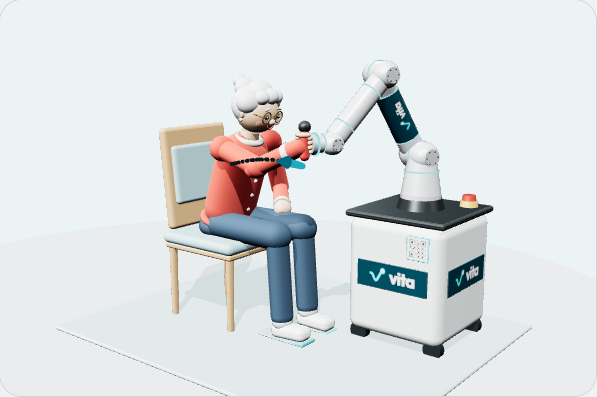 Forward reach1 / 6
Illustration. Muscle activity is not measured; the arm measures reach, angle and force.
The patient holds the handle and reaches forward. The arm carries as much of the weight as they need, and gives less as they get stronger.
Measures reach in centimetresThe arm leads the hand round a smooth circle, keeping the shoulder moving freely in every direction.
Measures range of movementLifting the arm as high as is comfortable brings back the range of the shoulder, step by step.
Measures lifting angle in degreesWith the elbow at the side, the forearm turns out and back. It loosens a frozen or stiff shoulder.
Measures rotation in degreesThe arm rests against the shin and pushes back. It rebuilds the thigh muscle after a knee or hip replacement.
Measures force in newtonsThe arm holds still and measures how hard the patient can push. The plan follows their measured progress.
Measures peak forceOne session
A patient never does an exercise just once. Each exercise is done in sets: a block of repetitions, then a rest, then the next set. Three or four exercises fill one session.
Example plans. The real numbers come from the patient's specialist.